
The campaign is working. Sales wants more budget to pursue the new market. Delivery wants more people to handle the customers already won. Both requests look reasonable.
You could approve both and still leave the most important question unanswered: what would have to be true about these customers for the combined investment to pay off?
This is how growth can make a company harder to run. Revenue rises while experienced people spend more time rescuing accounts and negotiating exceptions. Their effort protects customers. It can also conceal the weakness in the plan that brought those customers in.
Before increasing investment, follow the results across the business. A GTM strategy deserves confidence when you can explain how the company will fulfill its promises as demand grows.
What a GTM system includes
A go-to-market, or GTM, system connects how a business chooses customers, shapes its offer, wins business and delivers value profitably over time. It includes the operating rules and information that allow those activities to work together.
At Acuity, this is the foundation of how we think about growth. Customer selection affects implementation work. Pricing determines which promises the business can afford to keep. Delivery experience changes retention and the customer evidence available to Marketing and Sales.
The connections depend on decisions people can actually make. Does Sales have permission to decline an unsuitable deal? Does the person approving a discount understand its service obligation? Does delivery experience reach the next budget discussion?
A shared dashboard will not settle those questions. Leaders need to examine how a decision in one part of the business changes the work and economics elsewhere.
A cheaper opportunity can create a more expensive customer
Consider a fictional software company selling to a core customer segment and an adjacent market. Every new customer starts at $30,000 in annual recurring revenue, or ARR.
Measure | Core segment | Adjacent segment |
|---|---|---|
Acquisition spending per qualified opportunity | $2,000 | $1,800 |
Opportunity win rate | 25% | 10% |
Customer acquisition cost | $8,000 | $18,000 |
One-time onboarding cost per customer | $2,000 | $6,000 |
Original Acuity illustration. These are fictional assumptions and calculations, not benchmarks or client results. Acquisition spending includes marketing and sales costs, with shared costs allocated to the opportunities they support. Onboarding, the work of getting a customer using the service, is separate.
The adjacent opportunity costs 10% less to generate. But it takes ten opportunities to win a customer, compared with four in the core segment. Customer acquisition cost, or CAC, is therefore $18,000 against $8,000.
Including onboarding, that becomes $24,000 to acquire and onboard an adjacent customer, against $10,000 for a core customer. Both begin with the same ARR. Recurring service cost and retention still need examination; this is not a profit or cash-payback calculation.
Funding more acquisition may therefore create the delivery pressure behind the second budget request. The adjacent market could still be attractive with a different package, price or service model. That possibility deserves investigation before the company commits more money to the current approach.
Why delivery delays reach the next sale
Now suppose 18 implementation-ready customers arrive each month and the team completes 12. People keep working through earlier accounts while new customers join the queue. With no cancellations, the number awaiting completion grows by six a month, including both waiting and active work. Moving a customer into implementation does not clear that backlog.
The queue can also consume capacity. Sponsors chase dates, resources need rescheduling and senior specialists intervene on urgent accounts. If this work reduces completions while arrivals continue, the backlog accelerates. That worsening imbalance needs evidence; an accelerating curve is not inevitable.
For the customer sponsor, the wait is already costing something. They may have committed a budget and promised colleagues a result. Delayed value can weaken their support and leave less time to build adoption before a fixed renewal date. A renewal number can look healthy while risk is accumulating in newer accounts.
The consequences reach Marketing and Sales, too. A customer still waiting for value is unlikely to provide the success story or reference the next buyer wants. The experience after one sale has changed the conditions for winning another.
If implementation delays the transfer of a promised service, it may also delay revenue recognition under IFRS 15. Finance must assess the contract and applicable accounting, separately from first customer value, billing and cash collection. IFRS Foundation on revenue recognition
The same connections can create a competitive advantage
The opportunity is to make these relationships work in the company’s favor. Delivery learning can sharpen qualification and improve the offer. Customers who reach value reliably provide relevant evidence for similar buyers. Fewer avoidable exceptions leave more capacity to serve them well.
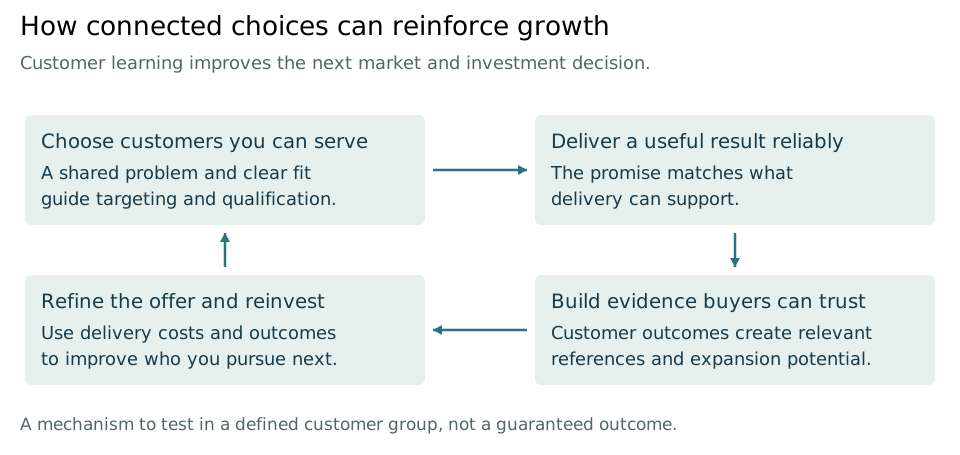
How customer learning can reinforce growth. Original Acuity illustration from the full Clarity Guide. Each connection must be tested in the business.
Michael Porter’s work on strategic fit helps explain why this matters competitively. A rival may copy an individual tactic more easily than a combination of activities that reinforce one another. The advantage depends on how the choices fit together. Harvard Business School on strategic fit
For a founder or investor, that is a stronger basis for expansion than a good quarter alone. It identifies the operating conditions worth protecting as the business takes on more demand.
Examine one customer group before the next commitment
Choose a material decision already on the table, such as a campaign increase or a new package. The CEO should name an owner able to bring together commercial, delivery and finance evidence. In a smaller company, that may be the founder working with the people closest to the accounts.
Follow a defined group of customers and compare it with a relevant group at a similar age. Bring four questions to the next leadership meeting:
What did we spend and promise to win these customers, including sales effort and exceptions?
How long did they wait to start, when did they first receive useful value, and who is still waiting?
What did serving them require, including rescue work, and what do comparable retention and margin records show?
What would make us change the proposed investment, and what evidence would challenge our preferred explanation?
Use the records already available and identify the gaps. A young customer group cannot yet demonstrate renewal performance. Protect customers who need help now while the investigation proceeds.
Then make a bounded commitment with an accountable owner, a spending or capacity limit and a review date tied to the relevant sales, implementation or renewal cycle. Where the backlog is growing, the delivery lead should review arrivals, waiting and active work, completions and rescue hours weekly with Sales and Customer Success.
Improvement should appear in customer value and economics, with less exceptional effort and without shifting the burden onto other accounts. Show valuable demand deferred or declined as well. You may still approve the original investment, but you will know more about what has to hold true for it to pay off.
Take the next growth decision through the full guide
How to See Your GTM System Before You Try to Fix It takes this example further, showing how customer mix can change retention and recurring gross profit even when individual segment performance is unchanged.
The full Acuity Clarity Guide includes seven diagrams and charts, twelve leadership questions, and a six-step method with a worked decision example and a working sheet for your next commitment. It also covers board discussions and how to sustain the discipline over the next ninety days.
Use it with your team to examine a live growth commitment before the next budget decision.